
How to Host a Braai in Zambia: The Foolproof Fun Guide

Learning how to host a braai in Zambia is one of the best investments you can make in your social life. Get the fire right and word spreads fast: suddenly your garden is the one everyone drifts towards on a Saturday afternoon, cooler box in hand, arguing happily about whose turn it is on the grid. This guide walks you through the whole ritual, from the first match to the last plate, with fire-building tricks, meat maths, etiquette rules and the side dishes that turn a simple grill into a proper Zambian braai. And stick around for the one thing nobody warns first-time hosts about: the morning after.
Why Is the Braai Zambia's Favourite Weekend Ritual?
In Zambia the fire sits at the heart of family life, and has done for generations. The traditional Zambian barbecue is the ritual that gathers everyone around it. More than 80 per cent of households still cook with charcoal or firewood, so cooking over live coals feels less like a hobby and more like a homecoming. Even as more kitchens go electric, the weekend fire has kept its place. The Bemba word insaka means a place to gather, and that is exactly what a braai becomes: a semicircle of chairs, a hiss of fat on coals, and conversations that drift as slowly as the smoke.
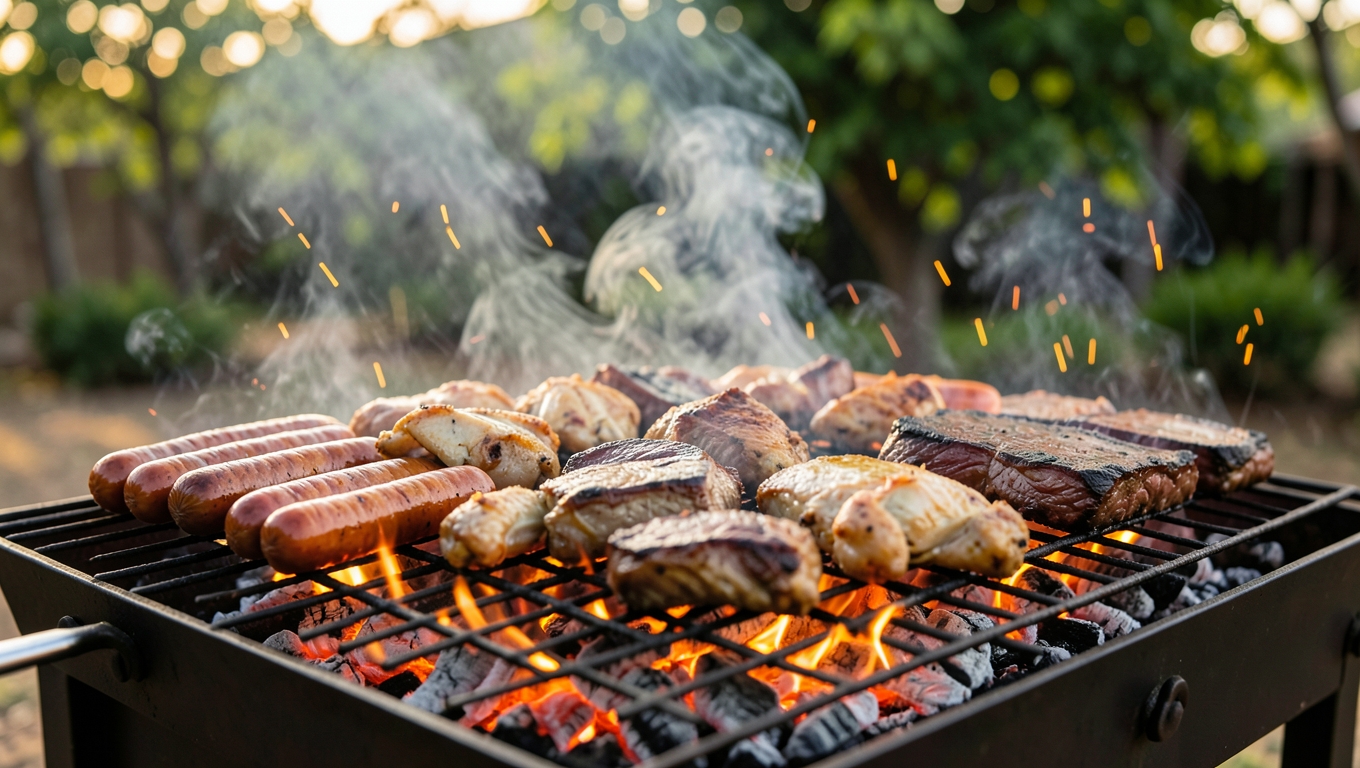
The main event: meat over glowing coals at a proper Zambian braai.
A braai is also wonderfully democratic. A mine manager and a market trader swap grilling tips over the same grid. Kids sprint between the garden and the cooler box. Somebody's auntie arrives with a dish nobody asked for and everybody fights over. Nobody checks whose car is parked outside, only whether there is enough ice.
A braai is not judged by the meat. It is judged by how long the last guest stays.
That is why the ritual matters here, and why the hosts who nail it become local legends. The good news: the whole thing is learnable. Fire, meat, sides, timing, and a few golden rules of etiquette. Let us take them one at a time.
What Do You Need Before the First Match Is Struck?
Great braais are won before anyone arrives. Walk through this checklist a day early, tick it off, and the day itself turns into one long, relaxed afternoon.
The braai stand. Any sturdy grill works, but clean the grid properly the day before so nothing from last time flavours today's meat.
Fuel. Charcoal or hardwood, enough for three to four hours and then some. Charcoal lights faster, wood gives more flavour. More on choosing below.
Firelighters and matches. Stored somewhere dry, checked the night before.
Tongs, a braai fork and a sharp knife. A spare pair of tongs saves marriages.
Meat, marinated and in the fridge. Buy it a day early, marinate overnight, thank yourself later.
Sides, bread and salads. Coordinate with guests so you do not end up with twelve potato salads. Unless that is your dream, in which case carry on.
Drinks and ice. More ice than feels reasonable, then one more bag.
Seating, shade and a bin. Guests gather where the chairs are. Put the bin somewhere obvious and the clean-up halves.
The first guest to arrive gets a job, a drink and the best seat. It is tradition.
How Do You Build the Perfect Braai Fire?
This is the part that separates a braai from a warm gathering around a disappointing pile of wood. The principle is simple: you are not cooking on the fire, you are cooking on the coals it leaves behind. Flames are for drama. Coals are for dinner. Here is the sequence that works every time.
Step 1: Build small first. Twist two or three firelighters into a bed of kindling and light them. This is your engine.
Step 2: Pyramid the fuel. Once flames catch, stack charcoal or wood into a rough pyramid with gaps for air. Fire needs oxygen more than it needs encouragement.
Step 3: Wait. Really wait. This is where first-timers panic and start flipping half-raw chops onto a raging flame. Resist. Let the flames die down and the coals turn grey and glowing. Usually 20 to 30 minutes.
Step 4: Spread the coals. Once they are ashed over, spread them into an even bed and add a few fresh pieces around the edge, ready to top up later.
Step 5: Test the heat. Hold your open palm above the grid at cooking height. Two seconds is fierce, three seconds is a good searing heat, four to five seconds is gentle enough for chicken and thick sausages.
Fuel | Personality | Best for |
Charcoal | Lights fast, burns steady, the weekday hero | Weeknight chops, quick family braais |
Hardwood | Takes patience, gives the best smoke and flavour | Long weekend braais where the fire is the event |
Gas | Instant heat, zero flavour theatre | Emergencies, and only emergencies |
One local note: in the dry months from May to October, an afternoon breeze can sneak up on you. Set up the stand so the wind blows smoke away from the seats, or you will host a braai that everyone remembers for their stinging eyes.
Flames are for drama. Coals are for dinner.
What Should Go on the Grid?
Now the fun part. A classic Zambian braai grid hosts a handful of stars rather than a dozen, done properly:
Chicken pieces over gentle coals, turned patiently and never rushed.
Beef steaks or chops seared hard on the hottest part of the grid.
A coil of sausage holding the middle, doing the crowd-pleasing work.
Village chicken, the local showstopper if you can get it, with a flavour that makes supermarket fillets feel like an apology.
Somewhere inside, a bowl of nshima and a spicy relish waits to complete the plate. That trio of meat, starch and relish is the heart of Zambian cooking, and a braai plate is no exception.
The maths of how much meat is the question every first-time host loses sleep over, so here is the rule of thumb used by braai guides across the region: plan around 400 to 500 grams of raw meat per adult, mixing two or three types. That works out at roughly half a pound of boneless meat per person in the guides' other favourite measurement. A mixed crowd with children averages closer to 350 grams each. Long afternoon? Add 100 grams. Vegetarians at the table? A separate grid solves everyone's worries, and a tray of marinated vegetables and halloumi will convert the sceptics.
Two more small touches separate good from legendary. Marinate overnight in something simple (oil, lemon, garlic, chilli, patience) and let the meat come to room temperature before it meets the grid. Then leave it alone. Turn once, trust the coals, and let the outside char while the inside stays juicy. The grid rewards calm hands.
Marinate overnight, trust the coals, and never argue with a hungry child.
What Are the Golden Rules of Braai Etiquette?
Every braai culture has its unwritten laws, and breaking one can get you quietly demoted to salad duty. In South Africa, where the braai is practically a national sport, hosts carry the proud title of braaimaster, and there is a national saying meaning "you do not mess around with another man's fire". Zambia runs on the same spirit. Here are the rules that keep the peace and protect your reputation.
The braai master rules the fire. One person builds it, one person works the grid. Advice is welcome only if requested. Backseat braaing is a crime in four countries, at least.
Never crowd the coals. Give the person at the grid arm room, a working angle and the respect a surgeon gets. Dinner depends on them.
At a bring and braai, you bring your own meat and drinks. The host provides the fire and, usually, the sides. Always confirm the format before you go, because "bring and braai" and "chop and dop" mean different things to different hosts. Surveys of braai guests found 87 per cent were unsure exactly what to bring, so when in doubt, arrive with a snack, something sweet, or flowers for the host.
Eat your own meat, share the rest. Around half of surveyed guests agreed everyone should ideally eat their own meat rather than a communal scramble. Offer a bite of your best chop, though. That is just manners.
Do not arrive hungry and do not rush the master. Snacks bridge the gap. The fire will be ready when it is ready.
Bring the energy. A braai is not a restaurant. Guests who help carry plates, hold babies, fetch ice and applaud the first perfect steak are invited back first.
Ask before reaching for another man's tongs. The fire forgives slowly.
What Sides and Drinks Complete a Zambian Braai?
Meat is the headline, but the table is the story. A braai spread in Solwezi or anywhere in Zambia usually builds around nshima, the staple maize porridge eaten by hand and shaped into a little spoon. Beside it comes a relish like ifisashi, greens simmered in a rich peanut sauce, alongside kapenta, the tiny dried fish fried with onions and tomatoes until crisp and punchy. Round it all out with the classics.
Station | What goes there | Why it works |
The grid | Chicken, beef, chops, sausage coil | The main event, served in waves as it comes off |
The table | Nshima, ifisashi, potato salad, green salad, garlic bread, roosterkoek | The gentle, starchy heroes that soak up the sauce and settle the spice |
The snack corner | Chikanda, roasted cassava, groundnuts | Keeps hungry guests happy while the coals work |
The cooler | Cold drinks, water, a local lager like a well-known beer named after the Smoke that Thunders | Thirsty work, standing around a fire all afternoon |
The dessert plate | Fruit, something baked, something sweet | The full stop (and the reason kids agree to leave) |
Zambia's national lager, Mosi, is named after Mosi-oa-Tunya, the Smoke that Thunders, and celebrated 50 years of brewing in October 2025. Even Victoria Falls itself, a World Heritage site recognised by UNESCO, has a braai connection: the name is all about smoke, and no braai worth attending ever lacked some.
In Zambia, a braai without nshima is just smoke with extra steps.
How Do You Feed a Crowd Without Losing Your Mind?
Three numbers do the heavy lifting:
Meat: 400 to 500 grams of raw meat per adult, mixed across chicken, beef and sausage.
Drinks: around two per adult for a standard afternoon, four to five if the afternoon is long and the stories are good.
Time: aim to eat within one to two hours of the first guest arriving, because hungry guests become creative snack raiders.
Guests (adults) | Raw meat to buy | Suggested mix |
6 | 2.5 to 3 kg | 1 kg chicken, 1 kg steak, 500 g sausage, 500 g extra for seconds |
12 | 5 to 6 kg | 2 kg chicken, 2 kg beef, 1 kg sausage, 1 kg chop |
24 | 10 to 12 kg | Double the twelve, add a vegetarian tray and a second grid |
Cook in waves rather than all at once. Send the first round out hot, and the table will do the rest of the work. Keep a bucket of water and sand near the stand as basic fire safety, and let the fire die down naturally when the plates stop coming back. A braai is a marathon with snacks, not a sprint.
Braai in Zambia: Quick Answers
These are the questions guests usually whisper to us while staring hopefully at the coals.
How much meat do I need per person for a braai?
Plan on 400 to 500 grams of raw meat per adult across two or three types, and closer to 350 grams per head for crowds with children. Always add a little extra: second helpings are the highest compliment your braai can receive.
What is the difference between a braai and a barbecue?
Temperature, fuel and spirit. A braai cooks over coals from charcoal or hardwood, takes its time, and centres on the gathering as much as the food. A quick gas grill gets dinner done. The braai gets everyone to stay.
How long does the fire take before I can cook?
Twenty to thirty minutes of patient waiting while the flames die and the coals ash over. Test with your open palm: two seconds above the grid is very hot, three is perfect for searing, four to five suits chicken and thicker cuts.
What do Zambians serve with a braai?
Nshima with a relish such as ifisashi, kapenta fried with onion and tomato, potato or green salads, garlic bread or roosterkoek, and a dessert for the patient. Chikanda and roasted cassava keep the crowd kind while the meat cooks.
What should I bring to a bring and braai?
Your own meat and drinks, plus a small gift for the host: a snack, a salad, something sweet, or a spare bag of ice. Confirm the format beforehand, because expectations vary and the only wrong answer is arriving empty-handed.
Can you braai in the rainy season in Zambia?
Absolutely. Build the stand under a roof overhang, a gazebo or a carport, keep the fuel somewhere dry, and enjoy the drama of cooking to the sound of rain on a tin roof. It might be the most Zambian afternoon of the year.
The Morning After: The Part Nobody Warns You About
Every great braai ends the same way: happy guests, full stomachs, and a crime scene in the kitchen. The sink wears a mountain of plates. The grid is welded shut with yesterday's marinade. Somewhere out there, a tablecloth has surrendered. Your car, parked faithfully beside the smoke all afternoon, is wearing a fine grey coat. And every jacket in the house now smells like a campfire, which is charming for exactly one day.
Here is the honest truth: no one ever regrets hosting. The clean-up is the only part of the ritual that never makes it into the stories. So do what the smart hosts do and hand the aftermath to someone else. Aenon Horizons has looked after homes and offices across Solwezi and Kalumbila for years, and the morning after a braai is our natural habitat. Our cleaning team resets kitchens, dining rooms and patios to spotless. Our laundry and dry cleaning service, with its bespoke scent bar, returns smoke-scented jackets and stained napkins to fresh. Our car wash and auto care team handles the ash-and-dust coating your vehicle collected from the braai. And for households that host often, our maid services and office cleaning teams keep the rest of life running while you plan the next gathering.
Every team is vetted, uniformed and trained, and every job is graded against our five-star quality-control system. Message us on WhatsApp at +260 978 789 767 or email info@aenonhorizons.com to book, and visit our services page and about page to see everything we do. Our office is on Kansanshi Road, opposite Yadah Christian School, Solwezi 10101, and you can book here. For more guides to life in North-Western Province, from things to do in Solwezi to everyday practicalities, browse our blog.
Host the braai. Keep the stories. Let someone else keep the dishes.


Comments