
Zambian Food: The Delicious Dishes You Need to Try

Zambian food is one of the great unsung cuisines of Africa, and this guide is your delicious introduction to it. From the satisfying mound of nshima eaten by hand to the nutty richness of ifisashi and the crunchy, punchy kapenta, Zambia's table is a story of maize, groundnuts, greens and fire, cooked with patience and eaten with company. Whether you are a visitor planning what to order, a new arrival learning to cook, or a long-time resident who has never quite dared to ask what chikanda is, this guide is for you: the dishes to try, how to eat them, what to cook first, and the dishes that will make you the most popular person at the braai.
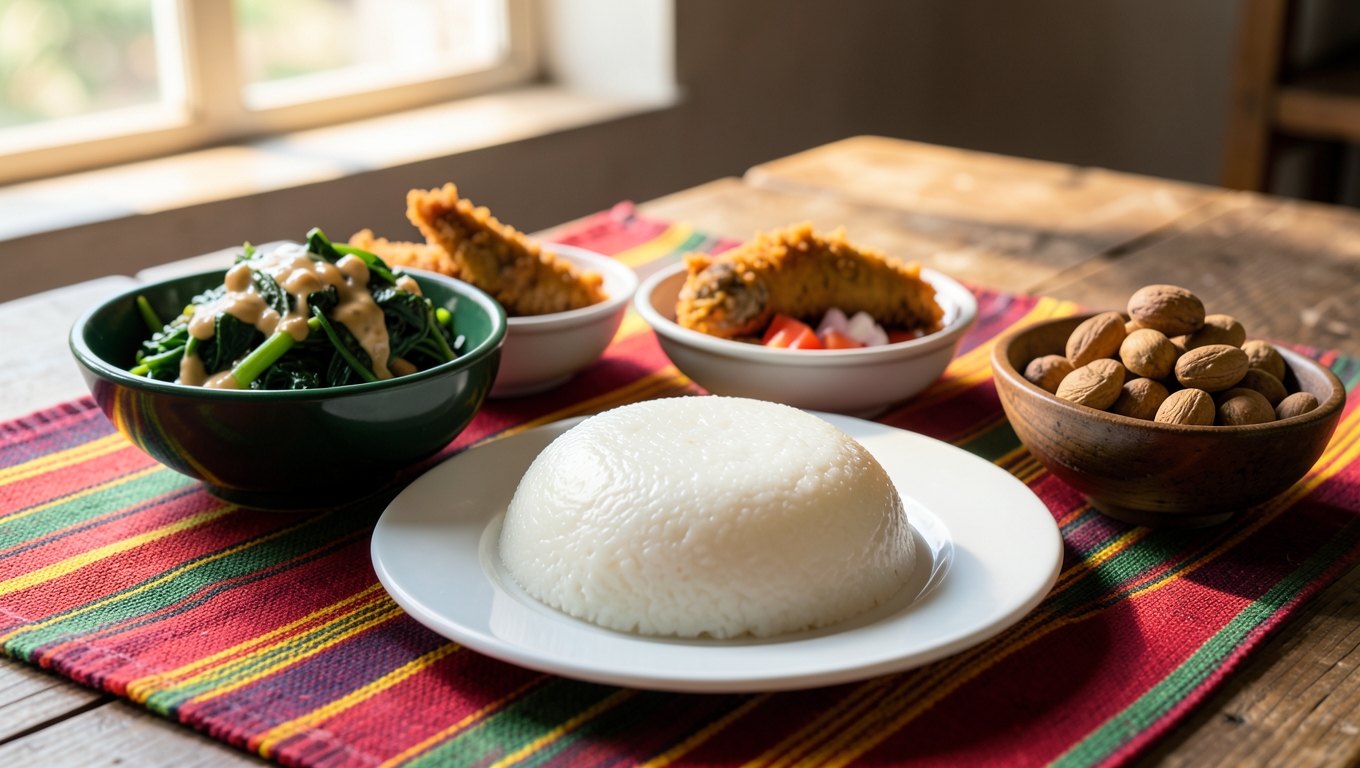
Zambia on a plate: nshima, ifisashi, kapenta and groundnuts, the heart of a real Zambian table.
What Is Nshima, and Why Is It the Heart of Every Zambian Meal?
Every journey into Zambian food starts with nshima. It is a thick porridge made from finely ground maize flour, known locally as mealie meal, cooked with water until it is smooth, stiff and ready to be shaped by hand. As the encyclopaedia of Zambian cuisine puts it, nshima is the main component of Zambian meals, served with "relish", stew and vegetables, and eaten by hand. It is not a side dish, and it is not a garnish: it is the centre of the plate, served with a relish known as ndiwo, and eaten at lunch and dinner in homes, food stalls and restaurants across the country.
The ritual is simple and wonderfully tactile. You break off a piece about the size of a golf ball, roll it in your palm until it is easy to work, press a thumb into it to make a little spoon, and use that to scoop up whatever relish is alongside. The technique takes a few tries and a good sense of humour. As travel guides to the country note, nshima is eaten with the hands, and the shared act of eating from the same pot or plates is central to Zambian family life.
Making it well is an art. The flour is cooked with boiling water into a paste, then paddled firmly against the side of the pot with a wooden spoon as more flour goes in, until the texture is exactly right: firm enough to hold its shape, soft enough to bite. Nshima is eaten across the region, from Zambia's nsima to Malawi's, Zimbabwe's sadza and Kenya's ugali, but every country insists its own is best. Zambia is right, of course.
Nshima is not a dish. It is the plate, the spoon and the conversation, all in one.
Which Zambian Dishes Should You Try First?
With nshima as your base, the fun begins. These are the dishes that define a Zambian table, and the order we recommend for first-timers building up their courage and their appetite.
Dish | What it is | Why it matters |
Ifisashi | Leafy greens simmered in a rich peanut sauce | The comforting, nutty star that makes vegetables a celebration |
Kapenta | Tiny dried fish fried with onions and tomatoes until crisp | Salty, crunchy, punchy, and the taste of lakeside Zambia |
Chikanda | "African polony": a firm slice of wild orchid tuber and groundnuts | An acquired texture for some, an obsession for many. The ultimate conversation starter |
Village chicken | Free-range chicken slow-cooked in a rich tomato and onion sauce | Firm, flavourful and the treat every Sunday table dreams of |
Chibwabwa | Pumpkin leaves cooked smooth with groundnuts | A soft, green, nutty classic that pairs with everything |
Kachumbari | Fresh tomato, onion and chilli salad, sharp and bright | The cool, zingy counterpoint to rich relishes |
A special word for chikanda, because it deserves one. Made from boiled root tubers of wild orchids, ground with peanuts into a firm, sliceable loaf, it is often called African polony and has a dense, savoury, slightly earthy taste that gets better with every bite. Slices are grilled or fried, wrapped in paper and sold everywhere, and the good news for plant-based eaters is that it is completely meat-free: chikanda is a genuinely Zambian vegan classic that predates the word vegan entirely. Ifisashi is the other great meat-free hero, and food guides to Zambia rightly note that vegetarians do well here, with beans in tomato, sauteed pumpkin leaves and chikanda all on the plant-based menu alongside the greens.
Chikanda: the dish that makes you ask what it is, then makes you ask for more.
How Do You Eat Zambian Food the Right Way?
Zambian hospitality is generous, and the etiquette is simple once you know the rhythm. Here is the crash course, so you can relax and enjoy the meal.
Wash hands before and after. A jug and basin may be carried round the table, or you may be directed to a tap. Take the hint with good humour.
Use your right hand for eating and scooping, the way nshima is designed to be eaten. Left hand for passing plates and drinks.
Roll, don't stab. Break off a small piece of nshima, work it into a ball, make a thumb indent to scoop the relish, and pop it in. No cutlery required, though spoons are fine if that is what is on offer.
Wait for the eldest or the guest of honour to be seated and invited to begin where it is a family meal; hospitality here means feeding people well, so expect second and third helpings, and accept at least one.
Ask questions. "What greens are these?" is the best compliment a Zambian cook can receive. The answer will come with a story, a recipe and a second helping.
Finish with fruit. Mangoes, bananas, watermelon and whatever is in season make the natural, refreshing end to a rich meal.
The first roll of nshima is a lesson. The third is a signature move.
What Should a First-Timer Cook at Home?
The best way to fall in love with Zambian cooking is to make it yourself, and the good news is that three dishes will give you a full, confident start. Start with nshima, add ifisashi, and let kapenta be your showstopper.
Nshima: bring water to a boil, whisk in mealie meal until it thickens, then fold and paddle firmly (a wooden spoon and a strong arm) until smooth and stiff. Rest, shape, serve with plenty of relish. This traditional nshima recipe walks through the paddling technique step by step.
Ifisashi: simmer chopped greens until tender, then stir in a smooth paste of groundnuts (peanut butter thinned with warm water), tomato, onion and a little chilli, and cook gently until the sauce is rich and the greens are coated. The peanut sauce is the whole point; do not be shy with it.
Kapenta: rinse the dried fish, dry them well, then fry with onion, tomato and chilli until crispy and deeply savoury. Serve hot beside nshima or rice, with kachumbari to cut the richness.
Extra credit: try the classic combination of the national dish and its most famous relish with this step-by-step ifisashi and nshima recipe, which walks you through the process from scratch.
Snacks while you cook: roasted cassava with groundnuts, and a big bowl of groundnuts on the table, are the traditional Zambian way to keep everyone cheerful until dinner lands.
Two tips from experienced cooks:
Buy fresh from the market. Choose your mealie meal and groundnuts where you can smell the freshness, and let the trader guide your choice.
Cook more nshima than you think you need. It is the friendliest food in the world for unexpected visitors, and unexpected visitors are Zambia's favourite kind.
Taste as you go. The peanut sauce for ifisashi should be rich but not heavy, and the kapenta should be crisp before it leaves the pan.
Cook too much nshima. In Zambia, that is not a mistake, it is a message: you are welcome here.
What About Drinks, Snacks and Street Food?
The Zambian table is more than three dishes, and the snacking culture is one of the country's great joys. Street food and snacks keep the town running: from roasted maize during the harvest season to fried cassava with groundnuts at the bus stations, there is always something to nibble on. And at every celebration, from Independence Day to a Saturday braai, the same heroes appear: chicken and rice, cool drinks and a table that keeps growing. The classic celebration plate is worth learning by heart:
Occasion | On the table | The vibe |
A family dinner | Nshima, ifisashi, a meat or fish relish, kachumbari | Quiet, generous, seconds guaranteed |
A Sunday treat | Village chicken in tomato-onion sauce, rice, greens | The week's reward, eaten slowly |
A braai or party | Braai meat, chicken and rice, nshima, a spread of relishes | Loud, long, and full of laughter |
A market morning | Chikanda slices, roasted maize, groundnuts, fruit | Snacks on the move, change in your pocket |
Drinks-wise, the local lager Mosi, named after Mosi-oa-Tunya, the Smoke that Thunders, has been a Zambian favourite for more than 50 years, and it is the classic partner to a braai. For children and drivers, fizzy drinks and water are the standard, and for anyone looking for something non-alcoholic, a glass of cold water beside a hot plate of nshima is quietly the best pairing of all.
Street snacks: roasted maize, fried cassava, groundnuts, and chikanda slices wrapped in paper.
Fruits in season: mangoes, bananas, watermelon, guavas and more, all sold fresh along the roads and at markets.
At celebrations: chicken and rice are the national party food, with braai meat, nshima and as many relishes as the table allows.
Drinks: Mosi lager for the braai, soft drinks for the family, and water for the drivers.
In Zambia, the food is the event. Everything else is just chairs.
Where Can You Try the Best of Zambian Food?
You do not need anything fancy to eat like a Zambian: the food is at its best where it is most loved. Markets and roadside stalls serve magnificent nshima and relishes at honest prices, matebeto-style spreads turn the traditional feast into a street-food celebration, and lodges and family restaurants in towns like Solwezi offer comfortable introductions to the classics. As Discover Africa's food guide notes, the communal way of eating, sharing one plate and one conversation, is central to Zambian everyday life, so the best tables are always the sociable ones.
If you are new here, the fastest way to learn is to ask a neighbour or colleague to take you somewhere they love. It is the beginning of a friendship and a culinary education in one. And if you cannot get the tastes out of your head afterwards, you are not alone: Zambian food has a way of following you home. For a fun, local guide to the wider region, see our things to do in Solwezi article, and if you plan to feed a crowd, our braai hosting guide completes the story.
Zambian food does not photograph well and taste badly. It does the opposite.
Zambian Food: Quick Answers
Newcomers ask us these questions most, usually with a plate of nshima in hand.
What is nshima made of?
Nshima is made from finely ground maize flour (mealie meal) cooked with water into a thick, stiff porridge. It is Zambia's staple, eaten at lunch and dinner, rolled into balls by hand and used to scoop up relishes like ifisashi and kapenta.
What is ifisashi?
Ifisashi is a Zambian relish of leafy greens simmered in a rich groundnut (peanut) sauce. It is comforting, nutty and naturally vegetarian, and it is one of the most popular sides served with nshima across the country.
What is chikanda?
Chikanda, often called "African polony", is a firm, sliceable dish made from boiled wild orchid tubers ground with peanuts and spices. It has a dense, savoury texture, is usually grilled or fried, and is a beloved Zambian snack and deli classic.
What is kapenta?
Kapenta are tiny dried fish that are rinsed, fried with onions, tomatoes and chilli, and served crispy alongside nshima or rice. They are rich in protein, full of flavour, and one of the most iconic tastes of the region.
Is Zambian food vegetarian-friendly?
Yes, more than most cuisines in the region. Ifisashi, beans, pumpkin leaves, chikanda and many relishes are plant-based, all served with nshima. Vegetarians should confirm that greens and beans have not been cooked with dried fish or meat stock, which is common in traditional cooking.
How do I eat nshima properly?
Wash your hands, use your right hand, break off a small piece, roll it into a ball, press a thumb indent into it and scoop up the relish. It takes a few attempts to get the technique, and nobody minds while you learn.
Feed the Family, Then Let Us Handle the Kitchen
Zambian cooking gives every kitchen a proper workout: the nshima pot that has to be paddled, the groundnut sauce that wants stirring, the kapenta that leaves its fragrance in the air for a day, and the mountain of plates and bowls that follows a full table of happy people. That is precisely why we exist. Aenon Horizons has looked after homes and offices across Solwezi and Kalumbila for years, and we know exactly what a big Zambian kitchen leaves behind:
The after-dinner reset. Our cleaning team takes on the pots, the surfaces and the kitchen that a feast leaves behind, so the cooking is all yours and the cleaning does not have to be.
Relish-proof laundry. From tablecloths to school uniforms, aprons to the shirt that caught the gravy, our laundry and dry cleaning service, with its bespoke scent bar, sorts the aftermath of every good meal.
Market-run car care. Fresh produce and open-market trips leave their mark on the seats and floors; our car wash and auto care team keeps the family car clean and comfortable.
Everyday backup. Our maid services and office cleaning teams keep homes and workplaces running, which frees up the time and energy for the fun parts of Zambian life: the cooking, the eating and the arguments about whose ifisashi is best.
Every team is vetted, uniformed and trained, and every job is graded against our five-star quality-control system. Message us on WhatsApp at +260 978 789 767 or email info@aenonhorizons.com to book, and visit our services page and about page to see everything we do. Our office is on Kansanshi Road, opposite Yadah Christian School, Solwezi 10101, and you can book right here. For more Zambian food and local life, browse our blog: from the game that runs the nation to the braais that feed it, there is plenty more where this came from.
Cook like a Zambian, eat like a Zambian, and let us deal with the washing up like professionals.


Comments