
Zambian Music: The Zamrock Story and the Songs You Need to Hear

Zambian music is one of the country's best-kept secrets, and once you hear the story you will wonder how it ever stayed hidden. In the 1970s, this country produced one of the most original rock scenes on earth: Zamrock, a fuzz-drenched fusion of psychedelic rock, funk and African rhythm that burned brilliantly through the copper boom years and then almost vanished. Today it is back, playing to packed crowds from Lusaka to Glastonbury, sampled by global stars, and inspiring a new generation of Zambian musicians. This guide is the fun, fast introduction: the genres, the legends, the songs to start with, and how to bring the sound of Zambia into your own house.
Where did it all come from? The country's musical heritage runs deep, from ceremonial drumming and thumb pianos to the guitar bands of the towns, and the 1970s scene grew straight out of that soil. Here is the journey at a glance.
Era | The sound | The story |
Traditional roots | Drums, thumb pianos and ceremonial song | The foundation of every Zambian genre that followed |
Early 1970s | Zamrock is born in the Copperbelt | Mine clubs, radio and jukeboxes fuse rock with African rhythm |
1972 to 1977 | The golden years | Witch, Musi-O-Tunya, Ngozi Family and Amanaz release the classics |
Late 1970s and 1980s | The silence | Economic hardship closes labels and empties venues |
2011 onwards | The revival | Reissues, world tours, samples by global stars |
Today | The new wave | Young artists fuse tradition, hip hop, Afro-pop and everything else |
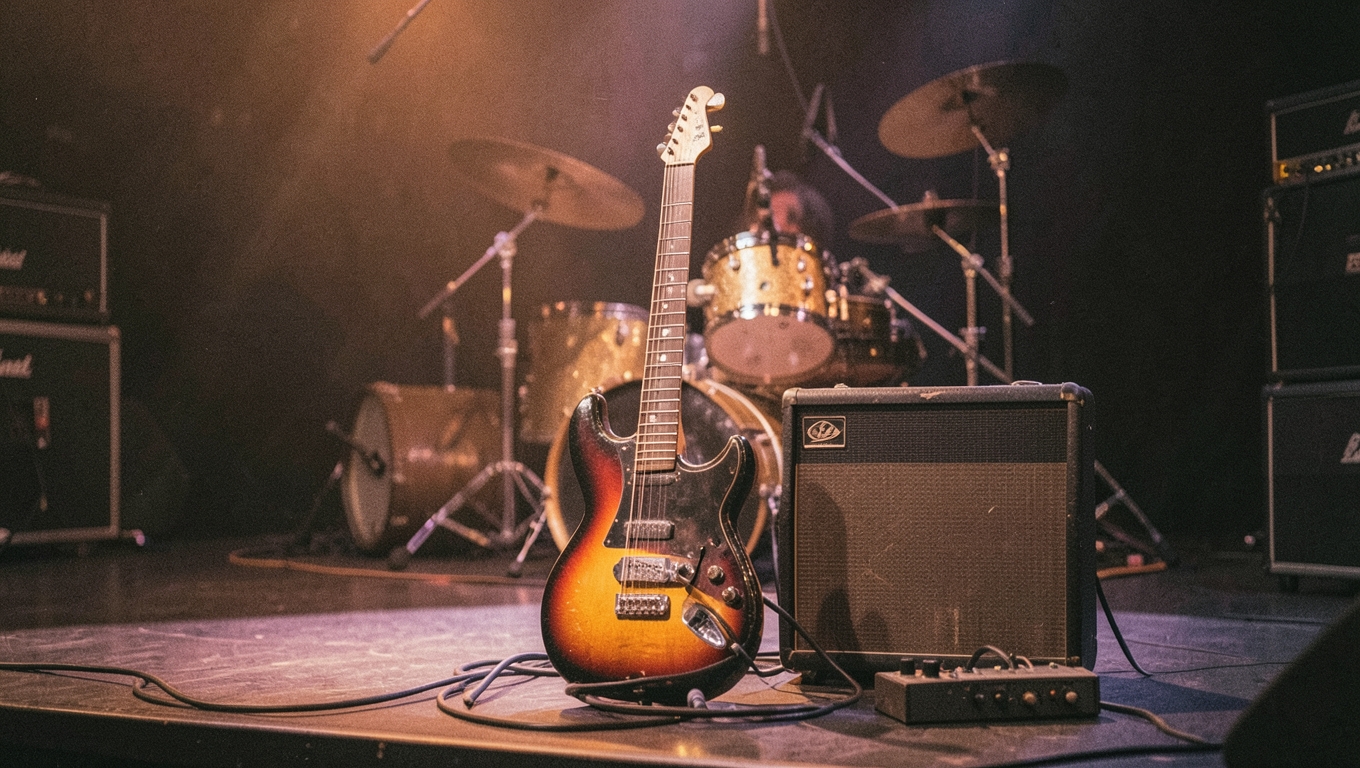
The Zamrock sound: a fuzz guitar, a hot amp and a dancefloor waiting.
What Is Zamrock, and Why Is the World Rediscovering It?
Zamrock is a music genre and scene that emerged in Zambia in the early 1970s: a fusion of traditional African music with psychedelic rock, garage rock, hard rock, blues and funk, taking influence from bands like Black Sabbath, the Rolling Stones, Deep Purple and Cream. It was born in the copper mining towns of the north, where miners' social clubs hosted live bands, and young Zambian musicians heard western rock on the radio and jukeboxes, then mixed it with their own rhythms and languages. As a Bandcamp Daily guide to the scene puts it, young bands armed with fuzzy, distorted guitars "built their own rock revolution in the Copperbelt" at a moment when music became a vehicle for liberation and modern identity. The result sounded like nothing else on the continent, or anywhere else honestly.
The scene's biggest band was Witch, an acronym for "We Intend to Cause Havoc", formed in 1971 and fronted by the charismatic Emmanuel Chanda, known as Jagari, a nickname inspired by Mick Jagger. Witch released five albums between 1972 and 1977 and became the face of the movement. As Jagari told the BBC, "We had the influence of rock and roll, but we were Africans, so we couldn't play the actual rock and roll. We had to fuse some things in." That fusion is exactly what makes Zamrock so special.
Zamrock is what happens when Black Sabbath meets Zambian drums, and everybody leaves as friends.
Which Bands and Artists Built the Zamrock Legend?
Every music scene has its Mount Rushmore, and Zamrock's is full of characters. Here are the names to know before your first deep dive.
Artist or band | Why they matter |
Witch (We Intend to Cause Havoc) | The scene's biggest band, formed 1971; five albums of fuzz and psychedelia, and a spectacular modern revival |
Rikki Ililonga and Musi-O-Tunya | Widely regarded as the inventors of the Zamrock style |
Ngozi Family and Paul Ngozi | Raw, wild and unforgettable; their albums are holy texts for collectors |
Amanaz | Their album Africa is one of the most treasured Zamrock records ever made |
Chrissy "Zebby" Tembo | Drummer and bandleader whose work straddles funk and hard rock |
PK Chishala | The beloved king of kalindula, the other great pillar of Zambian popular music |
PK Chishala deserves a special mention, because he takes the story beyond rock. He is considered by many to be one of the greatest musicians of the kalindula genre, the fast, folk-rooted Zambian style built on traditional rhythms and stories. Kalindula remains one of the country's most beloved dance-band traditions, still played at weddings and celebrations today. Where Zamrock spoke to the cities and the mine clubs, kalindula carried village folklore and everyday life into dance halls and radios. Together, they are the yin and yang of Zambian music in the 1970s and 1980s. As the encyclopaedia of the genre notes, the term "Zamrock" itself was coined by Zambian DJ Manessah Phiri, which shows how completely the scene belonged to the country, even when it borrowed its instruments from abroad.
One country, two legends: Zamrock plugged in the guitar, and kalindula plugged in the people.
Why Did Zamrock Disappear, and How Did It Come Back?
Zamrock's rise mirrored Zambia's boom years, and its fall mirrored the hard times that followed. When the economy struggled through the late 1970s and 1980s, the record industry went with it: pressing plants closed, venues emptied, albums went out of print, and original copies of records that once played in every mine club became almost impossible to find. For decades, Zamrock was a relic, unknown outside its own region, kept alive only by the people who remembered dancing to it.
The comeback began quietly with record collectors, and then all at once. In 2011, a reissue label called Now-Again released a Witch compilation, and interest exploded. The band reformed, toured the world, released new music, and became the subject of a documentary film. Jack White put out Witch live recordings, and artists including Tyler, The Creator, Travis Scott and Madlib have sampled Zamrock. In 2025, Witch became the first Zamrock band to play Glastonbury, more than 50 years after their first record. As one deep dive into the crate-digging revival describes it, the energy of those early shows, sometimes playing from 7pm until 2am, is exactly what collectors heard in those dusty records and could not forget.
They thought Zamrock was a fossil. It turned out to be a seed.
What Does Zamrock Actually Sound Like?
Here is the fun part: describing it. If you have never heard Zamrock, imagine the heaviest garage rock of the early 1970s, then hand the lead guitar to someone raised on Zambian dance rhythms, and let the bass player groove like a funk record. Add call-and-response vocals, lyrics in English and local languages, and a production warmth that sounds like it was recorded next to a jukebox in a miners' club. That is the recipe.
The guitar: fuzz, wah and big riffs, played with a rock swagger but a dance-band sense of rhythm.
The groove: funk and Afrobeat in the bass and drums, so the feet keep moving while the head bangs.
The vocals: English and Zambian languages, often shifting within the same song.
The vibe: raw, live and gloriously unpolished, recorded with more passion than budget.
The songs: long jams, sudden tempo shifts, and choruses that stay in your head for days.
New listener tip: give a song the first 60 seconds before you judge it. Zamrock tracks often open steady, then unfold into something much bigger, and the payoff always arrives.
Zamrock does not do polished. It does alive.
How Do You Start Listening (and Where)?
You do not need a vinyl obsession to enjoy this: the revival means the classics are streaming and on reissue. Start with the golden era and work forwards, then jump to the new wave. Open Culture's introduction to the scene even pairs a free playlist of the era's essential tracks with its history, which is a lovely way to hear exactly what the fuss is about. Here is a starter route that covers the essentials without overwhelming you.
Start with Witch: begin with the compilation released by the reissue label, then the classic albums; it is the perfect doorway into the scene.
Then go heavier: the Ngozi Family's early records, where Zamrock's rawest edge lives.
Add the inventors: Musi-O-Tunya and Rikki Ililonga, the birthplace of the sound.
Savour the songwriters: Amanaz for that album everyone recommends, and Chrissy Zebby Tembo for the funk-rock side.
Then the kalindula classics: PK Chishala and the dance-band tradition that kept the whole country moving.
Finish with today: modern Zambian artists are fusing it all again, and there has never been a better time to follow the scene.
For an even deeper dive, the Zamrock encyclopaedia page and the archives of the reissue labels are free treasure troves, full of band histories, record covers and stories from the golden years.
Start with one Witch song. You will finish the week as a Zamrock evangelist.
How Is Zambian Music Alive Today?
Very. Zambia today has one of the most exciting music scenes in the region: a young generation fusing hip hop, Afro-pop, R&B, gospel, gospel-rap and traditional sounds into something brand new, played on radio and blasted from phones in every minibus. The country's musical heritage is broad, from ceremonial drumming and thumb pianos to the guitar-band traditions of the towns, and modern artists draw on all of it.
The live scene is where it all comes alive. Lusaka's venues host everything from intimate acoustic sets to massive festivals, and in towns like Solwezi, celebrations and venues keep the dance floors busy. The revival of Zamrock has also taught a new generation an important lesson in confidence: that Zambian music can be unmistakably Zambian and still conquer the world.
How to get the most out of the scene, whether you are new to town or a lifelong fan:
Ask a local for their favourite artist. The answer is always passionate and always worth following up.
Follow the reissues. Reissue labels keep unearthing lost Zambian records, so the deep cuts keep coming.
Go to live shows. Zambian crowds make the music better; the dance floor is part of the performance.
Play it at your own gatherings. A Zamrock playlist is the fastest way to make any braai legendary.
Pass it on. Introduce a friend, especially a young music fan, to the golden era. The revival is generational.
Weddings and celebrations: the dance floor is a live-music treat; ask the DJ about local bands.
Radio and streaming: new Zambian artists are easier to find than ever.
Festivals: the big cities host music and cultural festivals through the year, and Zamrock legends now appear alongside new stars.
The old records: reissues of the 1970s classics make brilliant gifts, and a conversation starter in any living room.
Every generation of Zambian music has one thing in common: it refuses to sit still.
Zambian Music: Quick Answers
These are the questions we hear most from newcomers discovering the sound.
What is Zamrock?
Zamrock is a Zambian music genre and scene from the early 1970s, fusing traditional African rhythms with psychedelic rock, garage rock, hard rock, blues and funk. Bands like Witch, Musi-O-Tunya and the Ngozi Family made it one of the most distinctive rock movements in African history.
What does Witch's name mean?
Witch stands for "We Intend to Cause Havoc". Formed in 1971 and fronted by Emmanuel "Jagari" Chanda, they were Zamrock's biggest and most popular band, and their 2011 reissue sparked the modern revival.
Who is the most famous Zambian musician?
It depends who you ask, which is half the fun. For Zamrock, it is Witch and Jagari; for traditional dance music, PK Chishala, the beloved king of kalindula; and today, a new generation of stars is taking Zambian music worldwide.
Why did Zamrock disappear?
Zambia's economic difficulties in the late 1970s and 1980s ended the record industry that supported it: labels closed, records went out of print and the scene faded. The music survived in memories until collectors and reissue labels rediscovered it decades later.
Where can I listen to Zamrock?
The golden-era records have been reissued and are widely available on streaming services, as well as on vinyl for collectors. Start with Witch, then explore the Ngozi Family, Amanaz and Musi-O-Tunya. The reissue compilations are the friendliest entry point.
How can I experience Zambian music live?
Go out in Lusaka or your local town, ask which venues have live bands, and let the dance floor be your guide. Zambian audiences are famously warm to newcomers, especially ones who are willing to dance. And if you are in the north west, Solwezi's celebrations and venue scene keep the music playing year round.
The Music Is Loud. The Dust Is Not on Our Watch.
Here is a fact of Zambian life worth celebrating: music and cleaning go together, because the good times leave behind the good kind of mess. Hosting a listening night? A party that went long? Kids' instruments, a floor that saw a hundred dancing feet, laundry that smells like a great evening? Aenon Horizons looks after homes and offices across Solwezi and Kalumbila, and we are happy to be the quiet note after the last song:
The morning-after reset. Our cleaning team returns lounges, kitchens and floors to spotless after the party, with dust kept down through every season.
Gig-night laundry. From the shirt you danced in to tablecloths and curtains, our laundry and dry cleaning service, with its bespoke scent bar, handles it beautifully.
Gig-night car care. Venue parking and late-night runs leave their mark; our car wash and auto care team sorts that out while you relive the setlist.
Everyday backup. Our maid services and office cleaning teams keep homes and workplaces running, so your free time stays for the music.
Every team is vetted, uniformed and trained, and every job is graded against our five-star quality-control system. Message us on WhatsApp at +260 978 789 767 or email info@aenonhorizons.com to book, and visit our services page and about page to see everything we do. Our office is on Kansanshi Road, opposite Yadah Christian School, Solwezi 10101, and you can book right here. For more Zambian culture, from the dishes everyone loves to how to host a proper braai, browse our blog.
Turn the music up. We will make sure the house still shines when the last track fades.


Comments