
How to Clean Windows Without Streaks: The Complete Guide

Learning how to clean windows without streaks comes down to one unglamorous idea: a streak is residue, not dirt. Every cloudy smear on a pane is a film of something that never came off, whether that is mineral left by the water, soap that dried where it sat, dust carried back onto the glass by a dirty cloth, or a drop left to dry in the sun. Get the finish right and a whole house of windows is a morning's work.
Most window advice online was written for cold countries with soft mains water. Solwezi rewrites the problem: a week of dry-season wind lays a red film of mine dust over every window, borehole water leaves a chalky bloom wherever it dries, and burglar bars will not let a cloth meet the glass in a straight line.
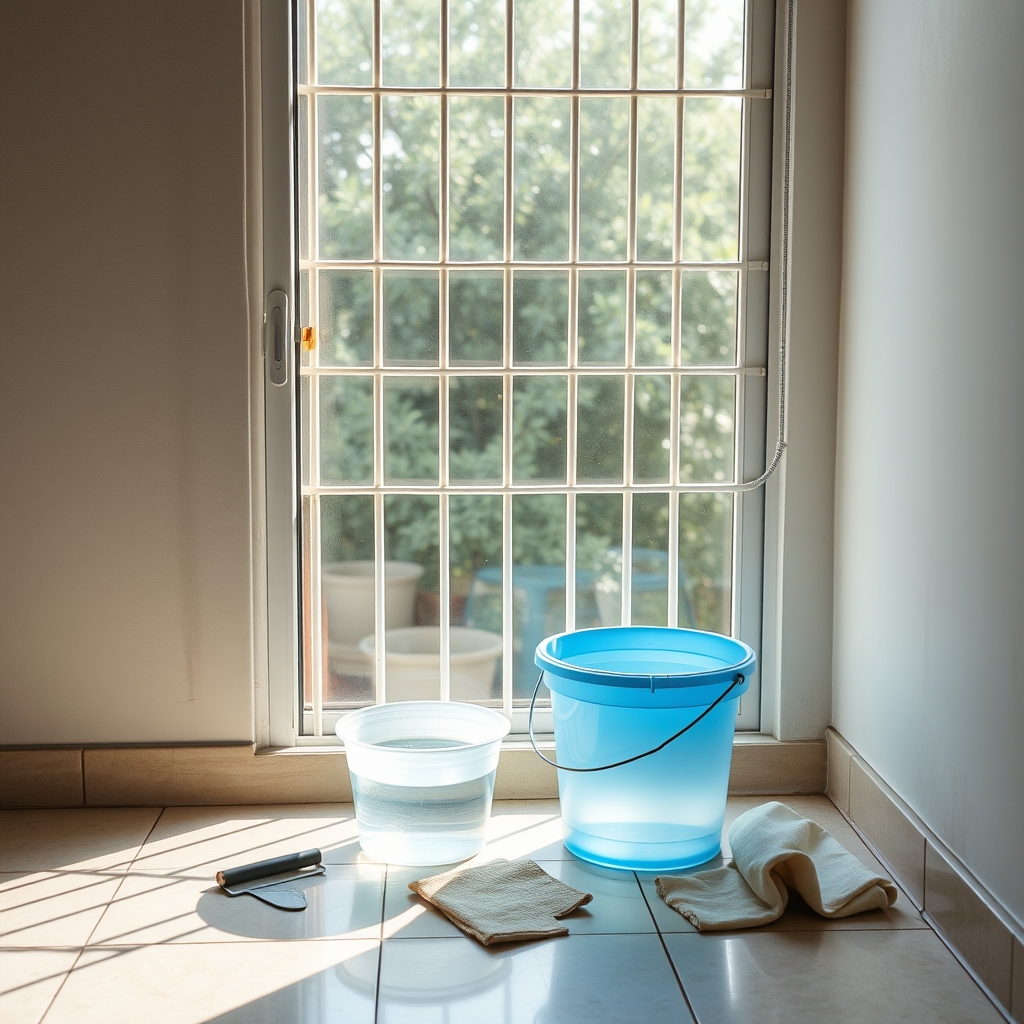
A squeegee pulled in one unbroken stroke down a wet pane is the difference between a clean window and a streaked one.
Why do windows streak when you clean them?
Start with the air. The World Health Organization estimates that household air pollution caused about 2.9 million deaths in 2021, with roughly 2.1 billion people still cooking on open fires or inefficient stoves, and soot from a brazier does not stay over the fire. It settles as a fine, oily film on glass and holds whatever lands next. Add a season of wind carrying red dust and you have a pane that looks clean from across the room and shows every smear once the sun comes through it.
So you are removing a film rather than a layer of dirt, which is why the finish matters more than the scrubbing. Modern panes are float glass, formed since the 1950s by floating molten glass over molten tin so both faces come out flat. Smooth to your eye, not to a cloth, and it carries whatever last touched it, which decides how the window looks.
People scrub a window for ten minutes and then dry it with a dirty rag in ten seconds. The rag decides the result.
What is the right order for cleaning windows?
Frames, sills and bars first, then glass, top to bottom throughout. Work one stage at a time across the house rather than finishing one window at a time, and clean the inside of every pane before the outside. A full house deep clean follows the same order, which our guide to how to deep clean your house sets out.
Brush or vacuum frames, sills, tracks and burglar bars.
Wash frames, bars and sills with soapy water, then dry them.
Wet the glass and scrub it, working from the top down.
Rinse so the pane carries clean water and not soap.
Squeegee or wipe dry, then finish the edges with a cloth.
Wash the glass before the frame and you have made yourself more work, not less.
How do you use a squeegee without leaving lines?
A squeegee does not wipe glass, it pushes water off it, and it only works on a pane that is wet through. Soak the window, scrub it, rinse it, then set the blade in the top corner and pull in one continuous stroke. Tilt the handle so the rubber keeps contact and the water runs to the edge you have not cleaned yet. Wipe the blade after every pass, because a dirty edge drags a line across everything it touches.
The tool itself is old and simple. The modern single-blade squeegee was patented by Ettore Steccone in 1936, a lightweight brass handle with a soft rubber blade, and he called it the New Deal. The same method cleans a car windscreen, and our post on cleaning a car interior applies it to glass you look through every day. If you would rather not use a blade, a good microfiber cloth works when it is damp and folded into a pad. Its fibres are under ten micrometres across, which is why it lifts film that cotton only smears around.
Working in direct sun, so the water dries before the blade arrives.
Too much soap, which needs two rinses instead of one.
A dirty or nicked blade, which is what those lines usually are.
Reusing grey water halfway through the house.
Drying glass with a cloth that smells like last week's floor.
One clean pull beats five quick wipes. If you have to go over the same pane twice, the blade is dirty and not the glass.
What is the best DIY window cleaning solution?
Water and a small amount of soap, and the water matters more than the soap. The USGS classifies water from 0 to 60 mg/L of calcium carbonate as soft, 61 to 120 as moderately hard, 121 to 180 as hard, and anything above 180 mg/L as very hard. Most Solwezi bores sit in the hard end, and every drop left on the glass dries out and leaves its minerals behind as a white bloom. Two or three drops of dish liquid in a bucket is enough to break the surface tension, and extra soap only means more rinsing.
The EPA notes that many volatile organic compounds run up to ten times higher indoors than outdoors, so there is no sense in filling a room with strong chemicals to clean a window you are about to open. If you do buy a bottle, the EPA's Safer Choice programme labels products that meet its standard for safer ingredients. A capful of white vinegar in the rinse water helps with mineral film, and a splash of methylated spirit helps a pane dry faster in humid weather. Neither belongs on tinted film or a hot pane in the sun.
Two mixes cover almost everything in a Solwezi house:
Job | Mix | Why it works |
Everyday interior glass | Three drops of Sunlight or dish liquid in 5 litres of water | Enough to lift film without leaving soap behind |
Rinse water for hard bore water | The same water plus one capful of white vinegar | The acid dissolves the mineral film that dries white |
Set white spots and shower glass | Vinegar and water, left to sit, then squeegeed | Time does work that scrubbing only scratches with |
Keep the soap under a teaspoon per bucket.
Never mix vinegar with bleach or with a bathroom spray.
Test anything new on a corner pane first.
Two drops of soap in a bucket is cleaner than half a bottle. The half bottle is a streak you built yourself.
How do you handle burglar bars, fly screens and frames?
Burglar bars are the reason so many Zambian windows streak along the top and bottom edges. You cannot get a squeegee between a bar and the glass, so water sits in the gap and dries there. Work a folded cloth around each bar, from the top of the opening downward, and dry each bar before you move on. Do the bars before the pane, never after, and the HSE's cleaning industry pages name slips, trips and strains as the injuries this trade collects, most of them from exactly this kind of reaching and twisting.
Part | Method | Watch out for |
Aluminium frames | Soapy water and a soft brush, then a rinse and a dry cloth | Abrasives and steel wool that strip the powder coating |
Fly screens | Take them out, brush both sides, wash, dry fully before refitting | Refitting a wet screen, which rusts the mesh edges |
Glass blocks | Warm soapy water, a soft brush into the joints, then a rinse | Soap left in the joint lines, which goes grey over time |
Scale on the pane | Vinegar and water soaked on, then a blade or squeegee | Scraping a dry pane, which scratches the surface |
High or first-floor panes | A telescopic pole from the ground, not a chair | Sills and bars that were never built to take weight |
For anything you cannot reach with both feet flat on the floor, use a pole. The HSE leaflet on working at height treats falls as a major cause of death and serious injury at work, and a householder leaning over a burglar bar to reach a top corner faces the same risk with worse footing. Real Simple reports that professional window washers clean the outside of high-rise buildings about twice a year, a fair guide to how often a tall outside pane needs doing.
When is the best time of day and season to clean windows in Zambia?
Early morning or late afternoon, and never at midday in the sun. Real Simple gives the reason plainly: direct sun makes a cleaning solution evaporate before you can lift it, and that is what leaves streaks. In Solwezi the easiest window weather of the year is the calm, soft stretch after the rains. ENERGY STAR notes that a standard double-pane window lets in about 75 percent of the sun's heat, and that certified windows cut household energy bills by up to 13 percent compared with single panes.
A season plan for a Zambian house:
Season | What the windows need | Why |
September to October, before the rains | A full inside and outside wash, frames and screens included | The first rains then rinse clean glass instead of baking dust onto it |
November to April, the rains | Inside glass, and splash marks on outside panes | Damp is a bigger threat than dust, so keep glass and sills dry |
May to August, dusty and cold | Outside panes monthly, inside as needed | Wind carries fine dust that settles on the glass within a week |
Overcast days and the morning after rain are the best conditions of all.
Outside panes about twice a year, interior glass about once a month.
Dusting before you wash saves a whole extra pass on the glass.
During the rains, glass is a smaller worry than water getting in, and our post on getting a home rainy season ready deals with that side of it.
Nobody's window went grey in a week. It is the month of skipping it that shows.
How do you keep windows clean for longer?
The habits matter more than the method once the glass is clear. Keep sills and tracks empty, because a sill full of dust is a fresh supply of streak material every time the wind moves, the same argument as our piece on how to declutter your home. Dry wipe the outside panes once a week in the dusty months, and deal with condensation instead of ignoring it, since a pane that stays wet grows mould at the edges. Our guide to mould and damp in your home covers that, and the NHS inform pages on damp and mould set out why a wet house is a health problem and not just a decorating one. An extractor fan or an open window moves that moisture out, which is what ENERGY STAR's ventilation guidance is for.
Keep a cloth and a squeegee in the house, not at the back of a cupboard.
Wipe the sill after every wash, while the cloth is still in your hand.
Fix the dripping tap or leaking gutter that splashes a pane every time it rains.
Paint or trim a flaking wooden frame before the paint lands on the glass.
Clean the glass as soon as building, painting or welding work finishes nearby.
Wipe the sill while the cloth is still in your hand. Nobody ever goes back for it later.
Window Cleaning in Zambia: Quick Answers
Short answers to the questions we are asked about glass in a Zambian house.
How often should you clean windows in Zambia?
Twice a year for the outside and about once a month for the inside is a sensible baseline. In Solwezi the dusty months from May to August push the outside pane closer to every three or four weeks, and a quick dry wipe in between brings the interval back out again.
Does newspaper really clean glass better than a cloth?
Newspaper works because newsprint is absorbent and slightly abrasive, and it leaves no lint, which is why the trick survived. It is also messy against wet ink and does nothing about mineral film that needs acid or a blade. A clean microfiber cloth does the same job with less fuss.
How do you clean the window above a kitchen sink?
Above a sink you are fighting cooking grease as well as dust, so start with hot water and a stronger soap mix, and wipe the frame and sill first, because that is where the film collects. Then rinse properly, twice if the pane still feels slippery, and squeegee in short strokes, since you rarely have room for a long pull past the tap. Our guide to cleaning your kitchen covers the grease side of the room.
How do you remove hard water spots from glass?
Soak the pane with equal parts white vinegar and water, or neat vinegar on a shaded window, and give it a few minutes before touching it. Once the film has softened, a squeegee or a scraper blade held almost flat lifts it off without gouging the surface. For heavy scale near a bathroom, repeat the soak rather than scrubbing harder.
Is vinegar better than dish soap for windows?
They do different jobs, so the honest answer is both. Dish soap lifts grease and dust and does the cleaning, while vinegar is an acid that dissolves the mineral film hard borehole water leaves behind. Use soap in the wash water and a capful of vinegar in the rinse, never with bleach, and never on a hot pane in the sun.
Should you hire someone to clean the high windows?
High panes, glass over a stairwell, and second-floor windows above a concrete yard are worth paying for. Quotes in Solwezi vary with the number of windows, the height, the state of the frames and whether materials are included, which is why a written quote after someone has seen the house is worth more than a figure given over the phone. Our guide on choosing a cleaning service in Solwezi lists what to ask before you agree.
Clear glass, and a house that stays that way
Windows are the last ten percent of a cleaning job and the part every visitor notices. Do the frames first, keep the soap low, rinse properly, pull the water off in one stroke and dry the edges, and glass that has looked grey for a season comes back in an afternoon.
If you would rather not spend a Saturday on a ladder, Aenon Horizons does this work every week across Solwezi and the rest of North-Western Province, for homes and plots as well as offices, alongside house cleaning, deep cleans, maid services, laundry and car care. The full range is on our services page, you can read how we work on the about page, and there are more guides like this one on the blog. For glass partitions and reception windows, our post on office cleaning in Solwezi sets out what a weekly visit covers. When you are ready, start on the contact page or head back to the homepage, call or WhatsApp +260 978 789 767, email info@aenonhorizons.com, or visit the office on Kansanshi Road, opposite Yadah Christian School, Solwezi 10101.
Ask any cleaner in Solwezi what a window needs and you will hear the same thing: clean water at the end, and a dry edge when you finish.


Comments